How to choose Tanzania safari accommodation? What is the difference between a Lodge and a Camp? Drawing on Tanzania safari route design and on-site camp research, Free Wilderness details Hotel, Lodge, Tented Camp and Mobile Camp types, along with who they suit and how to choose.
When first planning a Tanzania safari, many travelers are confused by the accommodation names on the itinerary. Hotel, Lodge, Tented Camp, Mobile Camp, Migration Camp... they all look like "hotels," but the actual experience can be completely different — especially "Camp." Many people think "camp" means ordinary camping tents, but in Tanzania safari, "camp" covers a very wide range: from mobile camps emphasizing pristine experience, to top luxury tented camps with en-suite bathrooms, bathtubs, private pools and butler service, sometimes even pricier than traditional five-star hotels. This article clarifies the accommodation types.
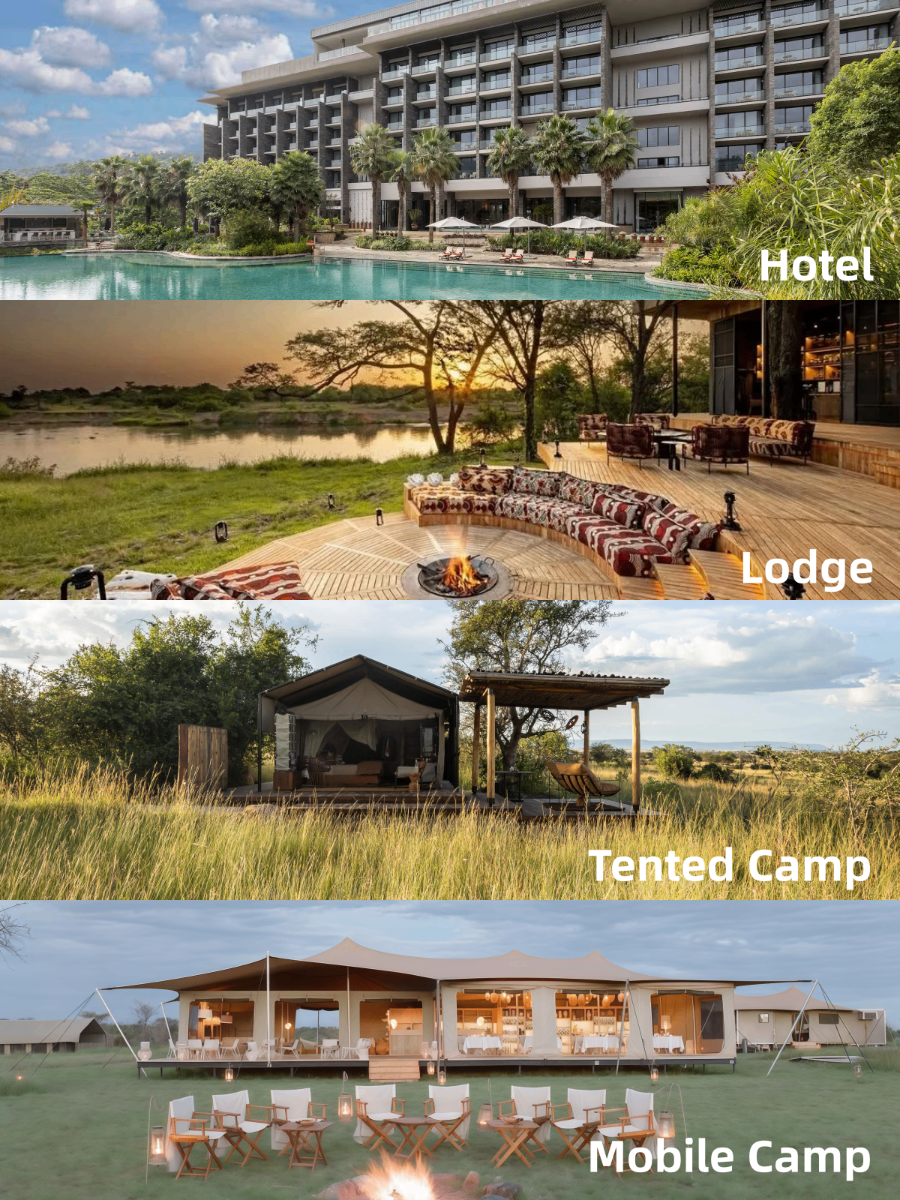
1. Hotel: mainly for city stays
Traditional hotels concentrate in cities like Arusha and Dar es Salaam. For a classic northern Tanzania safari, Arusha is usually a key transit city. Many international visitors arrive at Kilimanjaro International Airport and stay one night in Arusha before heading to Tarangire, Ngorongoro and the Serengeti. Once inside national parks and wildlife core areas, the accommodation focus shifts to safari lodges and various camps.
2. Safari Lodge: fixed buildings with more complete facilities
A Lodge is hard to translate simply as a "hotel." In the African safari context, it usually means a long-term, fixed-operating resort built with brick, wood and thatch — a small resort hotel in a nature reserve or wilderness. Its key features are fixed structures and relatively complete hardware.
Rooms usually have en-suite bathrooms, stable hot water and power, with restaurants, bars, pools, spas and viewing decks in common areas. Some high-end lodges also offer private pools, standalone villas and fuller resort facilities, e.g. Singita Sasakwa Lodge.
Lodge advantages
First, stable comfort: solid walls insulate sound, heat and wind better than canvas, which suits first-time visitors, seniors, young children and those who value sleep quality. Second, more complete public facilities: if you want swimming, spa, drinks or rest after afternoon game drives, a lodge more easily balances safari and resort experience.
However, a Lodge is not necessarily more expensive or higher-end than a Camp. Some well-located older lodges have more traditional hardware, while some top tented camps clearly exceed ordinary lodges in price and service, e.g. &Beyond Grumeti Serengeti River Lodge.
3. Tented Camp / Tented Lodge: not ordinary tents, but one of Tanzania's most classic safari stays
Tented Camp is the most easily misunderstood type. Seeing "tent camp," many imagine sleeping bags, shared bathrooms and outdoor camping. In reality, mid-to-high-end tented camps are closer to luxury hotels built mainly of canvas. They usually operate long-term in one area, so they are often called Permanent Tented Camps, e.g. Singita Sabora Tented Camp.
Rooms may be built on wooden platforms with large beds, furniture, en-suite bathrooms, hot water and private terraces. Some high-end products add bathtubs, private pools and outdoor showers. Compared to lodges, the biggest feature is a more immersive wilderness experience: at night, beyond the canvas is the savanna, with wind, birdsong and nearby wildlife sounds — a "truly living in the wild" feeling that many travelers remember most after their first safari.
Still, different tented camps vary greatly. Some emphasize pristine traditional safari atmosphere; others have become full luxury resorts with hardware, dining and service on par with lodges, e.g. Singita Mara River Tented Camp.
4. Mobile Camp / Migration Camp: camps that follow the migration
Mobile Camp and Migration Camp are very representative of Tanzania safari. Their key feature is that the camp position adjusts with the season and migration. The Serengeti is vast and the migration moves year-round — e.g. Jan–Mar calving in southern Serengeti and Ndutu, then moving through central, western and northern Serengeti, reaching the north and Mara River in Jul–Sep. If you stay fixed in one place, you may spend hours commuting to the season's core safari area. Mobile Camp reverses this: rather than driving far to find animals each day, the camp itself stays close to the season's main wildlife areas. That is the real value of a mobile camp, e.g. Roving Bushtops.
Are Mobile Camps lower quality?
Not necessarily. Because camps are seasonally assembled and moved, infrastructure is often less complete than permanent lodges — e.g. bucket showers or timed hot water, solar power, limited charging and network. Large pools and spas are rare. But "lighter hardware" doesn't mean "low-end."
Tanzania has many mid-to-high-end and even top mobile camps. Some invest heavily in dining, private bathrooms, guides and service teams, with prices exceeding ordinary fixed camps. For photographers and migration-focused travelers, the location advantage near wildlife areas can matter more than hardware, e.g. Asilia Olakira Migration Camp.
5. How Free Wilderness helps you choose Tanzania safari accommodation
Free Wilderness has long focused on African safari, polar and nature custom travel, with Tanzania as a core destination. In choosing Tanzania safari accommodation, we don't simply rank by "hotel stars," but combine travel month, budget and accommodation preferences.
For example, in the Serengeti:
- Jan–Mar calving season, focus stays near southern Serengeti and Ndutu;
- Jul–Sep Mara season, focus on northern Serengeti camp positions;
- For family travel, focus on room facilities, hot water/power, child policy and comfort;
- For photography or deep safari, prioritize location, guides and effective game-drive time.
The Free Wilderness team has visited Africa dozens of times, experienced nearly a hundred luxury camps, and maintains long-term partnerships with multiple African safari camps and luxury hotel brands. Through continuous field research, the team distinguishes camps by location, room condition, safari resources, service style and suitable travelers.
FAQ
QIs a Tented Camp just an ordinary camping tent?
No. Mid-to-high-end tented camps are luxury hotels built mainly of canvas, usually on wooden platforms, with large beds, furniture, en-suite bathrooms, hot water and private terraces. Some high-end products add bathtubs, private pools and outdoor showers — completely different from traditional camping.
QAre Mobile Camps lower quality?
Not necessarily. Mobile camp infrastructure is usually less complete than fixed lodges (e.g. timed hot water, solar power), but Tanzania has many mid-to-high-end and top mobile camps with high investment in dining, service and private bathrooms, sometimes pricier than fixed camps. For photographers and migration-focused travelers, location often matters more than hardware.
QWhich is better, a Lodge or a Tented Camp?
There is no absolute answer. Lodges insulate sound and heat better, suiting seniors, children and sleep-sensitive travelers; tented camps offer a more immersive wilderness experience with night animal sounds. Top tented camps can exceed ordinary lodges in price and service.
QHow to choose accommodation for a Tanzania family safari with kids?
Prefer lodges or permanent tented camps with stable facilities and fixed structures, and check hot water/power, child policy and room safety. Some camps have age limits — confirm in advance. Family travel usually suits fixed camps near southern Serengeti or Ngorongoro.
Interested in Africa?
Contact our dedicated travel consultant for a free one-on-one consultation and a bespoke African safari itinerary.
Plan My Trip